

In French, all nouns have a grammatical gender and are either masculine or feminine. On top of that, the masculine plural form is also used for mixed groups of people, such as different occupational groups. This means that many people tend to picture men more often when they read or hear a description of such a group.
Modern, gender-inclusive language is a counter movement. Instead of using the masculine form, alternative forms are used to refer to groups comprising both women and men. However, these forms have met with strong opposition, both from politicians and researchers, who argue that they make no difference and, moreover, render texts unreadable.
“I tested these two claims using surveys and experimental methods, including eye-tracking. The results show that participants found it easier to visualise women in a group if they read a gender-inclusive form rather than a masculine form,” says Julia Tibblin, a researcher in French at Lund University in Sweden.
Language shapes our perceptions
The research area is fairly new. When Julia Tibblin began her research in 2020, there were only a handful of similar studies – but these focused on German language forms. Her novel approach has led to her research receiving a great deal of attention both within and outside academia.
“There are two suggested approaches to creating gender-inclusive forms in French. One way to address this is by using gender-neutral language; for example, instead of saying “researchers”, one might say “the research team”, or replace “students” with “people who are studying”. The second is to use both the feminine and masculine forms. You can either write out both forms in full, or you can combine them into a single word,” says Julia Tibblin.
If we take the example of ‘students’ (étudiants), the gender-inclusive forms are either the two forms used together in a single expression:
• ”les étudiantes et les étudiants”
or a new word formed by combining the two forms with one or two dots in between:
• ”les étudiant·es”.
Two studies conducted by Julia Tibblin, involving almost 1,200 French speakers, show that readers more easily imagine women in the group when these two forms (’les étudiantes et les étudiants’ and ’les étudiant·es’) are used, than when gender-neutral or masculine forms are used. In the surveys, she has not used gender-stereotypical words such as “fireman”.
A matter of habit
She has investigated the criticism that these forms are difficult to read by conducting an eye-tracking study involving 75 people. The results show that the difference in reading speed is very small. The form with the dot takes the longest to read and may be a bit confusing at first, but that is all.
“It also seems that people get used to gender-inclusive forms over time, and that they are easier to read for people with positive attitudes towards gender-inclusive language,” says Julia Tibblin.
Politically-charged issue
Interest in gender-inclusive forms has come and gone over the years. As early as the 1960s, the French writer and philosopher Simone de Beauvoir employed such language in some of her novels. Since then, it has been used mainly by political activists and feminist groups.
These forms have therefore emerged from the grassroots, but in 2017 a textbook that used the forms was published, sparking a media storm and strong opposition in France. The Académie Française was outraged, speaking of a “deadly threat” and a “decline of the French language”. The then minister for education also banned the use of these forms in official documents.
“The Senate has just passed a bill that seeks to ban these forms in official texts. The issue remains highly politically charged in France,” says Julia Tibblin.
In the EU as a whole, however, the outlook is brighter. The Council of Europe updated its guidelines in 2024, recommending the use of gender-inclusive language, particularly in texts such as job advertisements and educational brochures. However, the recommendations are not binding; their application should be assessed on a case-by-case basis.
“They realise it’s necessary. These forms can be crucial in determining who feels like they are the intended recipient. By using only the masculine form, women are excluded – both from the perspective of the employer and the person applying for the job or studies,” says Julia Tibblin.
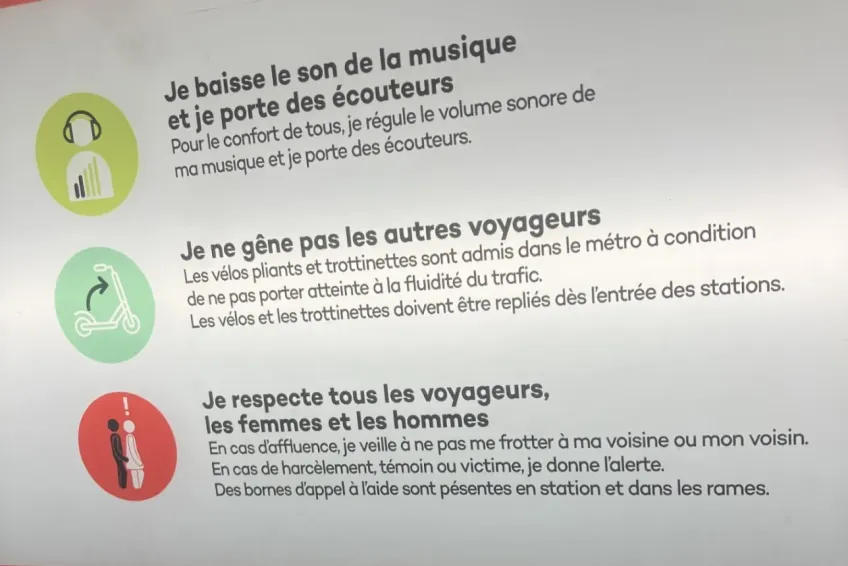
“I think these forms are here to stay. Now you see them in various types of text – on advertising posters in the Paris Metro and in university prospectuses, for example. “The dot symbol still has strong connotations of left-wing feminism, but it’s also used to signal that ‘we are modern and gender-equal’, “ says Julia Tibblin.