
Molecular Biology, Molecular Genetics and Biotechnology - Master Programme
Molecular genetics has deepened our understanding of genes and enabled new diagnostic methods. This programme prepares you for both a research career and roles in industry, where genetic discoveries are being transformed into treatments and biotechnological applications.
Start
Autumn 2026
Duration
2 years
Level
Master's
Language
English
Place of study
Lund
Advances in technology now allow us to sequence entire genomes quickly. The challenge for academia and industry is to interpret all this data and understand gene function. This Master’s programme equips you to contribute to that effort.
Molecular genetics combines biology, chemistry, and technology to explain how genetic information is expressed and how it shapes traits. You will gain in-depth knowledge of genetic engineering, cell biology, molecular biology, and biotechnology. The programme focuses on genetic mechanisms, including how defective genes can cause disease and form the basis for diagnostic methods.
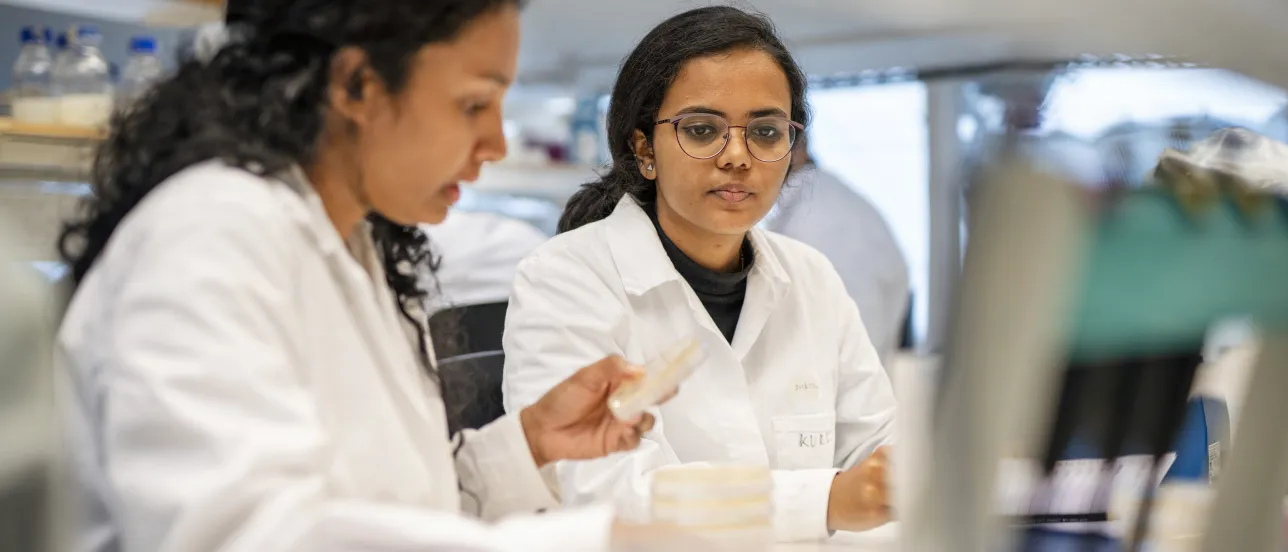
You will gain extensive lab experience and develop skills in experimental design and data analysis – preparing you for careers in pharmaceutical companies, biotechnology, and the food industry. The programme includes a high proportion of scheduled teaching and interactive learning, such as group work, seminars, and instructor-led exercises.
The educational environment and programme have a significant international character with strong research connections. The lecturers are accomplished researchers from the Department of Biology and other departments at Lund University. The programme is taught in English.
The first semester begins with a compulsory course in molecular genetics in eukaryotic organisms, focusing on genome organisation and gene expression. You will then choose an elective, such as immunology or molecular microbiology.
In the spring semester, you will take two core courses: genetic analysis and molecular biotechnology and methods. These cover gene inheritance, evolution, and the application of genetic knowledge across various fields. You will also take an elective, such as bioinformatics, where you can learn basic programming and DNA sequence analysis.
In the third semester, you can deepen your bioinformatics skills with advanced courses in sequence analysis and Python programming. You will also have the opportunity to attend research seminars and complete a short internship.
Your degree project can be 30, 45, or 60 credits and is carried out in a research group or at a company.
After graduation, you will be well prepared for doctoral studies in Sweden or abroad, as well as for roles in industry. Recent advances in molecular genetics have led to the emergence of companies developing genetic diagnostics and novel therapeutics.
Technological applications are also found in sectors such as biotechnology and food production, as well as in areas aimed at contributing to the development of a sustainable society – for instance, through genetic modification of plants to support agriculture and forestry.
Entry requirements
Specialisation: Molecular Genetics and Biotechnology Bachelor’s degree of at least 180 credits or the equivalent, of which 120 credits must be in science/biomedicine/engineering, including: 45 credits in molecular biology comprising genetics, cell biology and microbiology 30 credits in chemistry comprising biochemistry Proficiency in English equivalent to English 6/B from Swedish upper-secondary school.
Selection criteria
Based on grades awarded for previous academic courses and a statement of purpose for the application to the study programme (from the applicant’s “Summary sheet”).
Specific documentsComputers in the programme
The student must have access to a computer, preferably a laptop, on which you can install software mainly provided by the University, such as Microsoft 365, CAD/CAM and development environments for Python, Matlab or other computational tools. It can be either a Windows computer or a Macintosh computer. On some courses you may need to buy or rent your own software.
Conditions in the study environment and during study visits and field studies
The programme contains compulsory elements that require you to be able to work independently and safely in a laboratory environment, in a hospital environment, in workshops, in production facilities, or during study visits and field studies. These elements require the ability to comply with safety regulations, rules and instructions, and to move around in and evacuate premises safely.
Ethical concerns
The programme includes compulsory elements that some people may have concerns about, such as patient-centred activities in healthcare, animal testing or dissection. However, the student is obliged to acquire knowledge and skills in these areas as well, to the extent necessary to fulfil the learning outcomes of the course. For some elements, there might be specific requirements regarding rules on hygiene, protective work clothing, confidentiality and professionalism.
Tuition fees for non-EU/EEA citizens
Citizens of countries outside:
- The European Union (EU)
- The European Economic Area (EEA) and
- Switzerland
are required to pay tuition fees. You pay an instalment of the tuition fee in advance of each
semester.
Tuition fees, payments and exemptions
Full programme/course tuition fee: SEK 370,000
First payment: SEK 92,500
Note that you may also need to pay an application fee, or provide proof of exemption.
No tuition fees for citizens of the EU, EEA and Switzerland
There are no tuition fees for citizens of the European Union (EU), the European Economic Area (EEA) and Switzerland.
Lund University Global Scholarship Programme
The Lund University Global Scholarship programme is a merit-based and selective scholarship targeted at top academic students from countries outside the EU/EEA.
Lund University Global Scholarship
African Research Universities Alliance (ARUA) Scholarship
Within the framework of the Lund University Global Scholarship programme, the University also offers the African Research Universities Alliance (ARUA) Scholarship targeted at top academic students from selected African research universities.
Swedish Institute Scholarship: Global professionals
The Swedish Institute offers scholarships to international students from certain countries who are applying for select Master's programmes in Sweden.
Scholarship information on the Swedish Institute website
Swedish Institute Scholarship: Pioneering Women in STEM Scholarship
The Swedish Institute offers scholarships for Master's studies in Sweden for women from selected countries in Africa and Asia who want to pursue degrees in STEM fields. Check the country and programme requirements on the Swedish Institute's website to see if you are eligible for the scholarship.
SI Scholarship Pioneering Women in STEM
Country-specific scholarships and funding options
Lund University has agreements with scholarship organisations and funding bodies in different countries, which may allow applicants to apply for funding or scholarships in their home countries for their studies at Lund University. Most agreements are intended for Master’s applicants, although certain opportunities may also be available to Bachelor’s students.
External scholarships
In addition to scholarships offered by Lund University or through its partner agreements, there are external opportunities. On the page below, you’ll find examples of organisations that may provide financial support for international students from specific countries.