
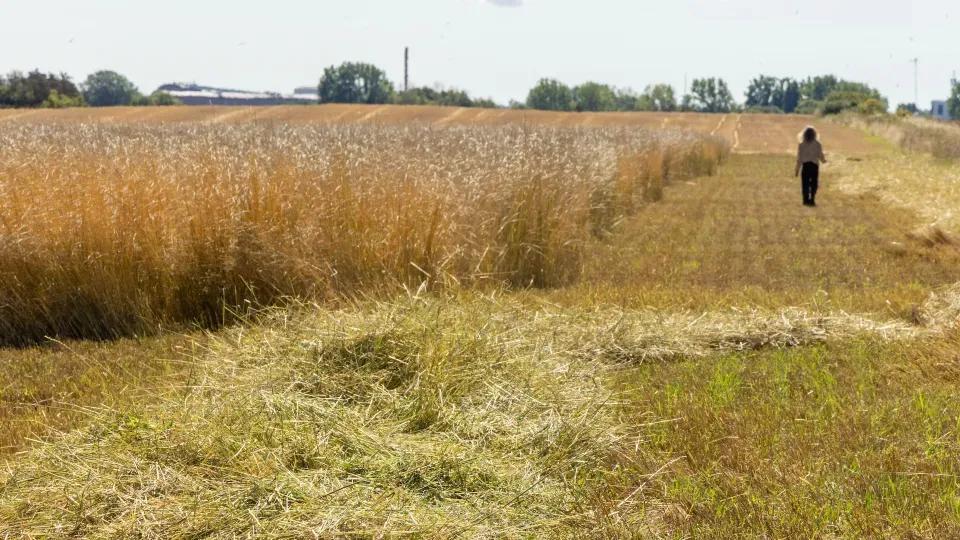
Kernza, a perennial grain with several metre long roots, is good for the climate and the environment. The grain, which is most closely related to wheat, has been approved in the USA, but in the EU it has not yet been approved as a food product by the EU’s food safety authority, EFSA.
Lennart Olsson, professor of geography at the Lund University Centre for Sustainability Studies, LUCSUS, is conducting the first large-scale cultivation trials of Kernza in Sweden.
What advantages does Kernza offer?
”There are three main advantages. Firstly, it’s a fantastic carbon sink. Our test cultivations in Alnarp, where we compare in real-time the carbon uptake for Kernza with more conventional crops such as rapeseed and wheat, show that Kernza binds considerably more carbon in the ground.”
“Secondly, it protects both soil and water. Because Kernza grows year after year without having to plough up the soil, it virtually eliminates erosion and nutrient leaching to groundwater and surrounding water in streams, lakes and the sea.”
“And thirdly, there is a significantly reduced need for weedkillers i.e. herbicides. In contrast to annual grains, Kernza can manage without chemical weedkillers once it is established. This is an important aspect because herbicides account for over 80 per cent of all pesticides in Swedish agriculture and have a negative effect on people and ecosystems.”
Yields are currently low compared with conventional grains. When can profitability and larger crop yields be expected?
“In the USA, Kernza is already profitable in certain circumstances because it’s sold as a niche product and costs several hundred kronor per kg. If the price is sufficiently high, Swedish farmers will also be able to make a profit. They can also save money on reduced costs for seeds and other inputs as Kernza remains in the ground. Our aim is for Kernza not to continue as a niche product, but to be used widely. Only then can we start a transformation of agriculture.”
“Regarding the crop yield, which is currently significantly less than for conventional wheat, the forecast is that yields could be comparable in 20 to 25 years. Plant cultivation is also taking place at SLU in Uppsala to develop types that are better adapted to the Swedish climate.”

Why has the process to approve Kernza taken so long?
“It’s mainly due to the EFSA’s regulatory system, which is not adapted for new grain crops and is based on the precautionary principle. This means that getting approval is difficult for new grains and, for example, products developed though biotechnology. In principle, all new food products that are to be sold in Europe, and were not on the market before 1997, must be approved.”
“In this case, the EFSA’s expert panel has identified various airborne microorganisms on Kernza’s outer shell, where the levels, according to the EFSA are to be below a certain limit. However, it’s not likely that any of the grains we eat today such as wheat, oats, rye and barley are below these limits, as bacteria is everywhere in the air. The problem is that the EFSA has never tested a grain before, it’s actually the first time in several thousands of years that we have a completely new grain.”
”The bacterial problems disappear when we use the grain to make final products, like bread, pasta, and beer.”
”The EFSA and expert group are increasingly aware of the problem and realise that today’s regulatory system is not wholly appropriate for approving new types of food products.”
It is already approved in the USA: why is that, and what is it being used for there?
“In the USA, the burden of proof is far less demanding: the requirement there is to show that no one has been harmed by eating Kernza. This is very different to the rigorous regulations of the EFSA. Since it was approved over ten years ago, it has been used in products such as bread, pasta, breakfast cereal, beer and even in whiskey and gin.”
“Today, many Swedish and European companies that produce new food products take a detour via the USA or Asia while waiting for approval in the EU. It’s a pity as this inhibits Swedish and European production, and consumers in Europe don’t get the chance to test the products.”
What happens when in the long run Kernza is approved within the EU?
“If it’s approved, the food industry and research on Kernza can really get going. Then we can continue with professional plant cultivation for increased crop yields, cultivate in larger areas and improve Kernza’s carbon uptake. However, if we get a rejection, we must start the whole application process again. That would be both expensive and time-consuming, as the tests that a new application requires take up to nine to twelve months to carry out.”
“Furthermore, I would very much like to see a radical rethink of the EFSA’s assessment criteria. An important aspect is that at present the EFSA does not factor in the potential benefits, in terms of ecosystem services for example, of a food product against its risks, their approach is based solely on the precautionary principle. I think this makes things difficult, as we quickly need to get grain and new products on the market for the sake of health and the climate.”